
Ventures, You're Wrong About FDE
You’re right that AI expands what one person can build. You’re wrong that the engineer is the unit.

Frontier vendors are selling against the services companies they want to replace, and I’ve spent eight years inside one of the targets. The pitch: a couple dozen forward-deployed engineers, a pile of agents, one person who takes a project from the first sales call through scoping, build, and deploy to the page that goes off at 2 a.m. Headcount drops 10x, output goes up. Services, minus the services company. Ideal?
I get why it sells. I also ran the original version of it myself, years before it had an acronym, so I know which part is true and which part is the part you learn about later.
Disclosure: I’m not neutral. The delivery side of a services company is my seat, and that’s exactly the thing this pitch is built to delete. Discount me for it. Then look at what the vendors actually do, because that’s the part that convinced me.
The Forward Deployed Engineer is a real role. It’s a real way to get a lot built fast. It is not the thing you scale a delivery business on. The deck folds those into one line. That line is what I want to pull apart.
I was an FDE before it had a name
Twenty years ago I was the whole team. Design, the front end, the back end, the box it ran on. Nobody had invented “product manager” yet, or if they had, the memo never reached me. The title was “webmaster.” One person, the entire stack, every project. That’s an FDE without the pitch deck.
Palantir gave it the name last decade, called its people “Deltas,” and put them on the customer’s floor writing production code on the customer’s own machines. All of that predates the AI wave. So the role isn’t new, and the AI part isn’t the interesting part. What’s interesting is what happened to the one-person model the first time around.
It got harder. The stack stopped fitting in one head, and the work broke into specialties. People call that bureaucracy now. It wasn’t. It was the only way to ship something that didn’t fall over.
Then we overdid it. By the time the agents showed up, the average project had so many narrow roles and handoffs that the work was mostly about managing the work. Standups about standups. The FDE pitch is a reaction to that mess, and the reaction is right.
Then agents snapped the loop back, and one person can carry a whole task again. That’s real, and I won’t argue it. The webmaster is back with a turbocharger. But “one person can carry the task” and “one person is what you build the company on” are two different claims, and the pitch trades the first for the second when you aren’t looking.
“FDE” doesn’t even mean one thing
Before we argue whether the unit works, look at the word. It points at three or four different jobs.
OpenAI and Google write it as an engineer: production code, system design, five-plus years. Aircall writes, in the actual posting, that it is not a software engineering job — a revenue role wearing solutions engineering and consulting. Mistral cuts it in two: an Applied AI Engineer who builds, a Deployment Strategist who handles the executives and the ROI math. Google keeps Customer Engineers running next to its FDEs.
So “just hire FDEs” is missing a question — which one? When the same three letters mean a coder at one company and a not-coder at the next, you aren’t hiring for a role. You’re hiring for a job the market hasn’t finished inventing. I wouldn’t put a P&L behind a word that unsettled.
Attention is a jug of water
One thing AI doesn’t touch.
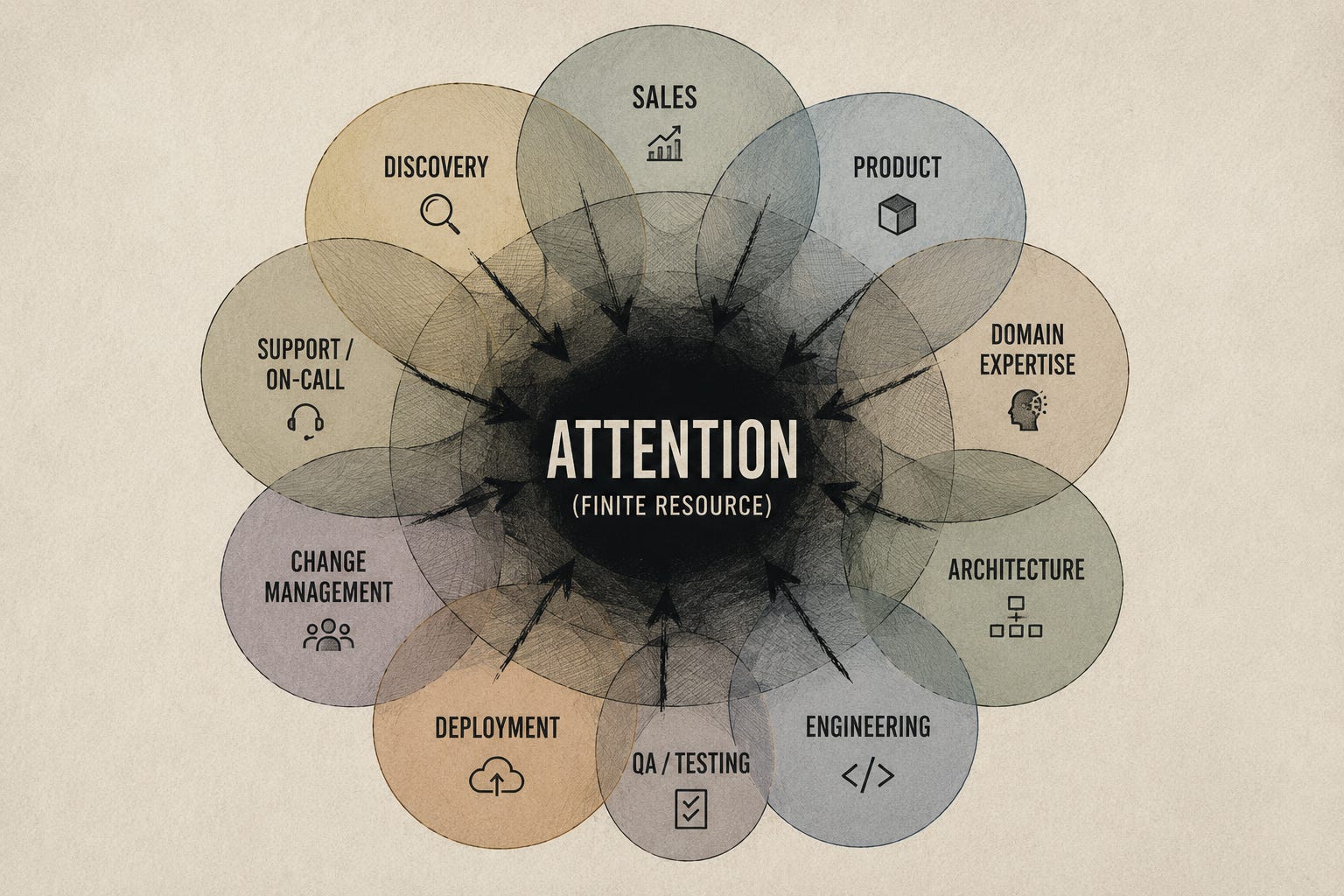
Attention is finite, and I think about it as a jug. You can put a drop in a hundred glasses or fill a few to the top. Nothing pours both. The one-person-does-everything model is making that choice whether the person admits it or not: either every stage gets a splash and comes out thin, or one stage drinks what the others needed.
AI doesn’t add water. It changes what a drop is worth.
A drop today is a one-shot generation, and it’s genuinely good — fast, real, usable. Half a glass is what you get when something gets a second pass: a few iterations, a critical read, a domain person who says “that won’t work here.” On a demo the drop and the half-glass look the same. In production they don’t, because nothing got enough attention to hold up.
The drop isn’t even worth the same to everyone. METR ran a controlled trial on senior open-source developers working in code they knew cold, expecting a speed-up, and clocked them 19% slower with early-2025 tools. A separate study across 4,867 developers found the reverse — about 26% faster, with the gains landing on the juniors. Read those together and the honest version isn’t “AI makes you faster.” It’s “AI changes the cost of a first draft, unevenly, and does nothing about the reviewing and wiring-in that come after.”
This isn’t new physics. A group that shares a picture of the system and splits the load beats one person holding all of it at once. AI raised how much one head can hold. It didn’t make the head bottomless.
A single FDE on a live account is splitting one jug across discovery, architecture, the build, the domain modeling, and the maintenance nobody puts in the quote.
Read the org chart, not the job title
I did the reading before writing this, because I didn’t want to swing at a strawman. To be exact about the target: not every investor, and not the engineers at the labs. The claim I’m against is the one in the decks and the partner memos — drop the services team, two or three forward-deployed engineers and a swarm of agents will cover it.
On the main point the market is right. The bottleneck is getting AI deployed, not getting access to a model. Postings are up 729% in a year, 643 to 5,330 from one April to the next, per Indeed. OpenAI’s FDE is a serious role — production engineering, base near $265K, total comp past $350K with equity. Nobody made this up for a slide.
Now look at how they staff it. OpenAI’s FDE is a unicorn, and they don’t send the unicorn in alone: there are technical deployment leads, delivery leads, a platform team backing the “customer-tagged FDE pods.” Then they went and stood up a whole separate company for it — around 150 experienced people from the Tomoro acquisition, four billion dollars behind it, built to do the workflow-redesign and adoption work at scale. Anthropic isn’t selling a lone engineer either — it’s training 30,000 people through Accenture and parking “reinvention deployed engineers” next to its own applied staff. AWS’s “forward deployment” is a team with scientists and strategists in it, and it’s one item on a menu, not the whole offer.
The people who coined the pitch don’t run the pitch. They send a team with an organization behind it. The lone FDE lives on the slide they show you, and they already paid for the part about attention. They just took it off the version of the slide pointed at companies like mine.
The hard part isn’t the code
The generation story ends at “the model produced something,” and that’s the cheap 20%. The expensive part is everything the pitch skips: redrawing the workflow, getting the data clean enough to use, wiring into systems older than the customer’s current CTO, the governance sign-offs, the people who’d rather the thing didn’t work, an ROI number specific enough to survive a budget review. A faster code generator speeds up none of it.
The numbers say it plainly. Gartner expects 40%+ of agentic AI projects cancelled by the end of 2027, on cost, fuzzy value, and weak controls. Deloitte’s 2026 survey: a quarter of companies have moved even 40% of their experiments into production, 74% expect to be running agents within two years, and 21% have governance mature enough for them. The space between “produced” and “in production” is where projects die, and it’s built out of exactly the work one overloaded person has no attention left for.
A read, and I’ll flag it as a read. The money isn’t blind to durability — good investors are obsessive about retention and margin. The problem is the clock. The pitch gets judged before durability can show up: the demo lands in week one, the thing holds or breaks around month nine, and the check gets written somewhere in between. DORA has spent ten years showing that delivery is throughput and stability together, and that scoring a team on output alone is a known way to fool yourself. You don’t find out which one you bought until the money has already moved.
When it works, it really works
I’m not saying deployment is a money pit. Done right it’s the whole point, which is why I care who does it.
Morgan Stanley got around 98% of advisors using its assistant, with documents going from mostly out of reach to reachable. Klarna’s bot took 2.3 million chats in its first month, about 700 agents’ worth, and dropped resolution time from eleven minutes to under two. One CodeRabbit rollout cut review time by roughly a third and caught more bugs along the way.
None of those is a lone genius. Each one is a capability dropped into a real workflow with people doing the integration and the trust-building and the adoption around it. The win sits in that surrounding work, not in how few people you squeezed it onto.
Yes, one person can do it. I’ve done it.
Let me make the other side’s best case for them, because it’s real. One strong engineer with agents can now do what used to need a squad. I’ve watched our people do it. I’ve done it myself. The research on “hero” developers backs the instinct — across 1,100-plus projects, concentrated talent often lifts output, and in enterprise codebases their commits ship with fewer bugs. Concentration isn’t automatically a problem. I’ve spent enough of my career leaning on a few exceptional people to know it works.
Here’s what the pitch leaves out. It works when the one person is a staff-level generalist — already carrying the judgment, the domain, the memory of how the system actually behaves — pointing the AI and correcting it across every layer, with the checks still running. The AI didn’t replace a team in that story. It multiplied one expert. What it couldn’t supply is the thing you can’t prompt for: a correct spec and a real model of the system in someone’s head. Take that person out and it doesn’t repeat.
The developers in Stack Overflow’s 2025 survey land in the same place. They use AI constantly, and more of them now distrust its accuracy (46%) than trust it (33%), with the most experienced the most wary. Their top complaint is the answer that’s “almost right, but not quite” — the kind of wrong that eats more time than it saved. The human doesn’t leave. The human moves to where being wrong is expensive.
I learned this with years and money, not from a paper. We started the company on people. For a long stretch delivery rode on a handful of unusually good engineers who could each take a project end to end — our FDE era, before the term existed. It worked, and it didn’t scale, for a boring reason: we couldn’t hire more of them. The people with that stack weren’t on the market. So we built a training platform, because there was no other way to grow — 3,471 signed up, 128 ended up working with us. That’s the lesson in two numbers. You don’t scale on heroes. You build the thing that makes more of them, and a hero won’t build that for you.
And before this reads like I’m pointing at someone else — we do it too. We built one of these solo-plus-agents products in about two months. Sharp idea, it ran, it demoed great, the kind of thing that makes you believe the old way is over. Then it sat. It didn’t answer a real problem, because one wrong turn at the start quietly becomes a whole product when you’re moving that fast and skipping the step on purpose. Same tokens, same dazzling demo as anyone else. What stuck with me: it was real and it didn’t scale, because the guy who pulled it off was one guy without a team — and speed makes it cheap to build something polished that points at nothing.
The unicorn you can’t afford
There’s a money version of this, and the venture crowd should feel this one especially.
OpenAI pays its FDE into the mid-six figures, and then pays again for the whole organization standing behind him. That second number is the real cost of the role, and the solo pitch sells you the dream of skipping it. You can copy the shape of what OpenAI does. You can’t copy the budget under it, and the pitch charges you for the shape while shipping you one person.
I rebuild our financial model every quarter now — line by line, where an agent is genuinely cheaper than a person and where it only looks that way on the slide. The thing the model keeps showing me: this is a labor business wearing software margins. Utilization is a tax you always pay. Your best person is a single point of failure. You can’t clone the unicorn when two clients want him the same week. Investors price it like software — build once, copy forever. It bills like labor — one person, one client, one calendar. A labor-bound capability on a software-bound valuation isn’t a strategy, it’s a write-down with a delay on it, and the people who eat it are the ones who believed headcount really fell 10x.
The unit is a team, not an engineer
The fix is not to march back to narrow roles and standups about standups. I lived that and I don’t want it back.
The durable forward-deployed unit is a team. I call it an FDT, a Forward Deployed Team. Not one body per function. A small group whose attention, added up, covers the whole spread — people who go deep in one area and stay useful across the rest, roles overlapping on purpose. A few jugs aimed at the glasses that actually matter. Which, again, is what every vendor selling you the solo version runs in its own building.
One person generates fast. A team gives each stage enough attention to survive the customer. AI made the first one cheap and did nothing for the second, and the second is what clients are paying for.
So, to the venture crowd: the FDE isn’t wrong for being ambitious. As a role, it’s right. As a way to generate, it’s right. It’s wrong as the unit you scale delivery on — generation dressed up as delivery, and the two stopped being the same thing the minute the work got real. You’re not early here. You’re on the second lap of a track some of us already ran.
The edge belongs to whoever ran the first lap and remembers the answer was never a better individual. It was a team. How that team gets built and run with agents inside it — who holds which jug, where the agents sit, what stays human, how you keep it from sliding back into standups about standups — is the real question, and the one I’d rather spend the next piece on. I have a working answer. It’s earned, not theoretical. This isn’t the place for it.
The jug doesn’t get bigger. That’s the one thing the pitch needs you not to think about.
Sources
The role and the market
Palantir’s origin of the FDE — The Pragmatic Engineer
OpenAI Forward Deployed Engineer posting — OpenAI Careers; comp context — Levels.fyi
“Not a software engineering role” — Aircall FDE posting
The split model — Mistral AI Deployment Strategist
FDE postings up 729% YoY — Indeed data via Business Insider/AOL
How the vendors actually staff it
OpenAI Deployment Company (~150 FDEs via Tomoro, $4B+) — OpenAI
Anthropic × Accenture (~30,000 trained, “reinvention deployed engineers”) — Accenture Newsroom
AWS Generative AI Innovation Center (embedded teams; forward-deployment engineering) — AWS
Generation vs. delivery
AI made experienced devs 19% slower — METR RCT
+26% completed tasks across 4,867 devs (larger gains for juniors) — Management Science
>40% of agentic AI projects cancelled by 2027 — Gartner
25% to production / 21% mature agent governance / 74% planning agents — Deloitte, State of AI 2026
Throughput and stability, not output volume — DORA
Trust in AI accuracy (46% distrust vs 33% trust; experienced most cautious) — Stack Overflow 2025 Developer Survey
When deployment lands
Morgan Stanley ~98% advisor adoption — CDO Magazine
Klarna: 2.3M conversations / ~700 agents / 11→<2 min — Klarna
CodeRabbit review time −~35% — CodeRabbit / Common App case study
Concentration and its limits
“We Don’t Need Another Hero?” (heroes across 1,100+ projects) — arXiv 1710.09055